Chairs!
As an offshoot of my interest in woodworking, I have a strong interest (my wife would call it an unhealthy obsession) in wooden chair-making.
As such, I've accumulated a long "to-build" list of chairs. Some are based on existing plans by woodworkers, and then others are inspired by chairs but will ultimately end up my own interpretation.
What kind of chairs are we talking about? Well, there's lots of types of chairs, even when limited to wooden ones. I can name at least two broad categories that are popular in the chairmaking world, and they happen to be the ones that interest me. Among those two broad categories fall some sub-categories as well.
Two Basic Styles of Chairs
Sticks and a Plank Seat
First, we have chairs that consist of a plank/platform (the seat) that provides the central point for the legs to connect to. The back and arms, if there are any, connect to this plank from the top. Essentially, the legs and back are separate pieces.
The main categories of these types of chairs are Windsor chairs and Stick Chairs. Stick Chairs are often described as a vernacular, of the people, windsor chair. While they can be simple or complex, they usually lack a lot of the ornamentation that windsor chairs are known for.
Stick chairs can be made with a minimum amount of tools and historically may have been built by farmers during their off-season, or any other working class type of person. Historical chairs are often full of flaws, and often make use of natural curves in the wood to save on shaping work. You might see legs skewed at different angles, or mismatched wood in repairs.
The nice thing about stick chairs is that when building your own, the marks from hand tools and any flaws or imperfections that come with the chairs are actually embraced instead of treated as a bad thing. Many of these imperfect chairs fetch a pretty penny at antique stores.
Then there are windsor chairs. These are the fancier versions of these platform chairs. The legs and spindles are usually turned on a lathe. Steam bending is often used for complicated curves. The shapes are more refined and usually have a lighter weight appearance.
There are two broad styles of Windsors: American and English. American windsors usually have more elaborate turnings, more dramatic leg angles,
and only backsticks rather than a backsplat. English windsors, on the other hand, have steeper leg angles, and often have a carved backsplat.
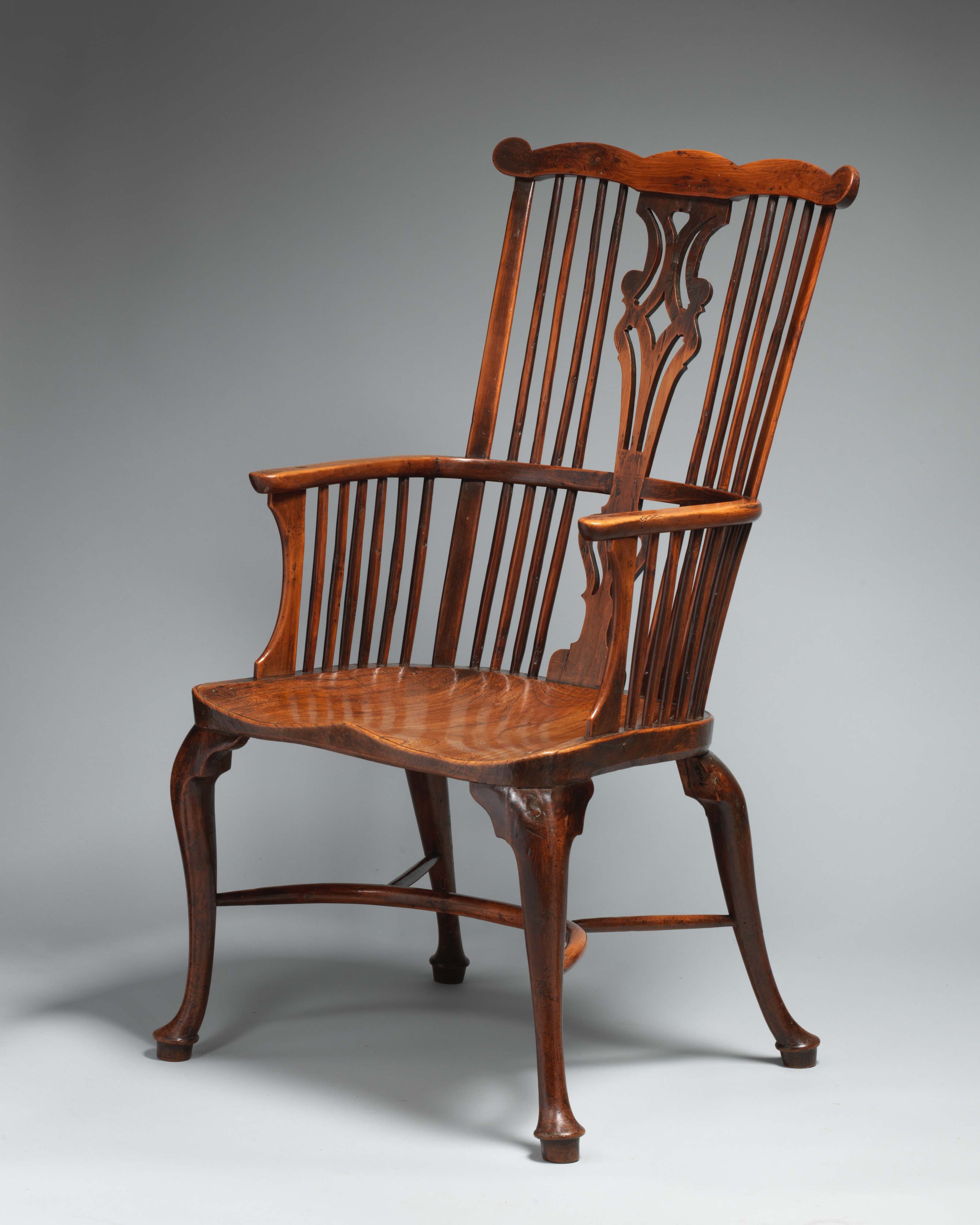
Some well-known chairmakers of this style are Curtis Buchanan, Peter Galbert, John Brown, Christopher Schwarz, Chris Williams, and Drew Langsner.
Curtis Buchanan lives in historic Jonesborough, Tennessee where he designs and builds windsor chairs. He is a well-regarded chairmaker and sells plans for his chairs on his website. He has a popular chair he named the "Democratic Chair" which has a "pay what you can" set of plans and free video lessons on how to build it. The idea behind the Democratic Chair, which has nothing to do with politics, is that it can be made with few handtools to help more people access the craft, thus a chair for the people.
Peter Galbert works out of Maine and builds fantastic windsor chairs. He published a book, The Chairmaker's Notebook, which tells you all about how to construct two windsor chairs and is loaded entirely with hand-made drawings he made. It's a great resource and he has helped advance chairmaking due to his writing. You can find more of his work at his personal website
John Brown was an English/Welshman who spent the later half of his life building and writing about traditional Welsh Stick Chairs. He can be credited with inspiring the chairbuilding careers of Christopher Schwarz, Chris Williams, and pretty much any stick chair maker since he wrote his small book, Welsh Stick Chairs. His book first covers the history of the Welsh Stick Chair and styles, and he then goes on to build a variant of one of his "Cardigan Chairs". He never made the same exact chair twice, which is part of the appeal to Welsh Stick Chairs. You embrace the uniqueness and the imperfections. Chris Williams (below) worked alongside him and wrote a book documenting his woodworking years and his relationship with John Brown. It's a worthy read if you're into this niche interest.
Chris Williams makes Welsh stick chairs in the traditional way. He does not work to a plan which ensures that each chair is unique. He studied under John Brown and worked closely with him. He is also the author of a book on John Brown's life which includes rough directions for a Welsh stick chair at the end. His website holds his chair portfolio.
Drew Langsner is famous for hosting his Country Workshops for decades at his property. He hosted other woodworkers and it seems that a lot of current chairmakers got started with taking classes that Mr. Langsner held. He also published some books on chairmaking, including the hard-to-find Chairmaker's Workshop. Thankfully I was able to snag a limited run reprint of the book. He is also one of the modern "pioneers" of green woodworking that helped spark a revival, alongside Jenny Alexander, whom I write about in the next section, and Peter Follansbee.
Christopher Schwarz is an author, book publisher, and woodworker. He is a former editor of Popular Woodworking as well. He writes in a way that pulls people in, and through his company, Lost Art Press, you can find over a decades' worth of blog posts. He gives away so much of his writing for free, however, now he has a personal woodworking blog called The American Peasant that has some free content and a paywall for other posts. He generously gives away free PDFs of all of his books he's written for Lost Art Press in the name of sharing knowledge (and it's probably a good publicity stunt as well), so if you aren't sure that you want to purchase one of his books, check out the writing first.
Personally, I've found his philosophizing on life to be refreshing. He also has a big historical focus to his work and helps educate about types of furniture one might never have been aware of otherwise. Through him I've learned about John Brown, stick chairs, and hand tool woodworking techniques. One of my favorite books of all time (not just woodworking-related) is The Anarchist's Design Book. It has a healthy dose of philosophy (why build overly fancy furniture that your bosses' boss would want? It looks out of place in most middle-class homes), and the projects are split into two sections: boarded furniture, and staked furniture. At first I balked at the staked furniture section of the book. I thought, "I don't care about that. The chairs look weird and I'm not interested." However, they quickly grew on me, and with the release of another of his books that is entirely dedicated to stick chairs, The Stick Chair Book, I've become a fellow stick chair evangelist.
While Mr. Schwarz is interested in building other things, it is clear his passion is in chairmaking and he's found a niche that he likely doesn't regret. He passes this passion onto his readers. You might notice I've linked to a few Lost Art Press books here. This is because he has an entire section of his company's website dedicated to chairmaking books (I've linked in the bottom section). He also has a serial publication called "The Stick Chair Journal" which is a nice collectible. Each issue has articles on techniques, highlights of different chairmakers, and has a new chair project to build. He has opened it up to other writers/builders in his social circle, but hopefully in the future, he will expand the submission process to the general public, as I'm sure there's plenty of people who could contribute excellent articles and keep the journal going.
I write the most about him because I am obviously a big fan of his work and plenty of others are too. You will find most of his followers will build not just one of his projects, but most of them. It's almost like a rite of passage. In my opinion, while Mr. Schwarz might disagree, I believe Christopher Schwarz has done more for hand tool woodworking, and passing on valuable knowledge than any other woodworker alive today.
Post and Rung
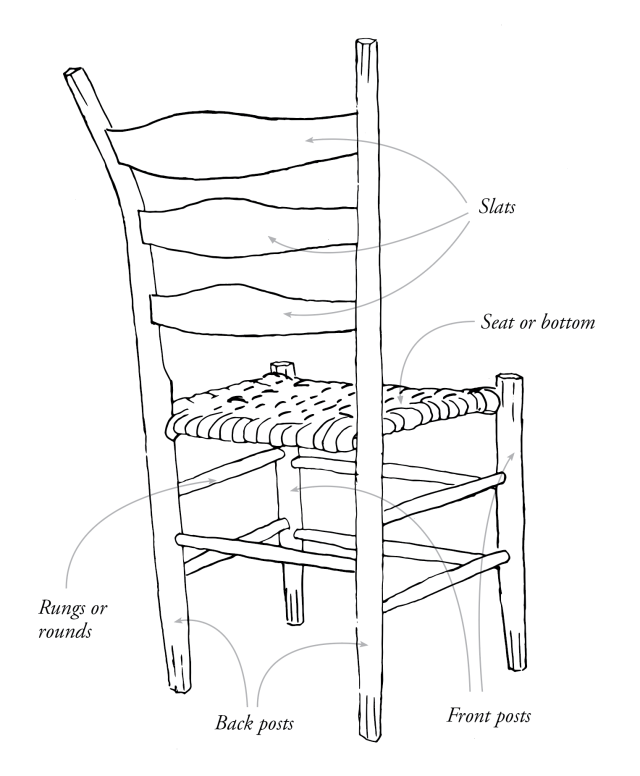
Post and rung chairs consist, as the name suggests, of vertical posts and horizontal rungs. The back legs run continuously and serve as the posts for the backrest. Post and rung chairs do not have a solid seat (those modern upholstered chairs might fit under this definition and they have solid seats) but typically a woven seat of rush reeds, twine, shaker tape, or bark instead.
Some examples of post and rung chairs are the famous Shaker chairs, Appalachian "settin'" chairs, and many historical New England-made chairs. Many of these can be referred to as "ladderback chairs" because the horizontal slats in the backrest form ladder-like steps, but not all post and rung chairs have backrests like this. Some define a third type which is similar to this style but uses flat woodworking joints rather than using round sticks and posts. They call them "joined chairs" but I think of them as falling under post and rung. Three well-known ladderback chair makers are Jenny Alexander, Brian Boggs, and Andy Glenn.
Jenny Alexander wrote the book Make a Chair From a Tree that shows you what is possible using fresh lumber from a log (green woodworking). Jenny Alexander spent decades refining the chair and revised the book two times. The chair is famous for how light-weight it is and using the least amount of lumber required to get a comfortable chair. It is referred to as the "Jenny Alexander Chair" or simply the "JA Chair."
Brian Boggs is a famous chair designer and builder. He designed and built many post and rung chairs out of Kentucky (the center of the Appalachian ladderback chair world), and his most known works are his "Berea" chairs. There is a side chair (no arms), an arm chair, and a rocking chair. They are very comfortable chairs. Boggs decided to stop teaching classes on these chairs and instead licensed out the plans so that others can teach classes and learn to build these great chairs. Jeff Lefkowitz designed a very technical manual for each of the chairs, along with many others that he offers for sale on his website. Mr. Lefkowitz worked alongside Boggs and now teaches how to make the chairs. The small handful of other chairmakers that teach how to build this chair refer to Lefkowitz' manual for guidance. A couple other instructors that teach this chair are David Douyard in Connecticut, and Shea Alexander in Virgina.
Andy Glenn is located in Maine and makes both basic types of chairs but I associate him more with post and rung. He wrote an awesome book called "Backwoods Chairmakers" that profiles the disappearing Appalachian chairmakers throughout the Appalachian region. It's a very niche topic so I won't find anyone in my personal circle to read it, but I wasn't interested in post and rung chairs until reading his book. Now I'm obsessed with them. The book also has plans for two chairs that I intend to build, but he has one in particular on his portfolio that really draws me in and I've added to my build wishlist.
Parts of a Chair
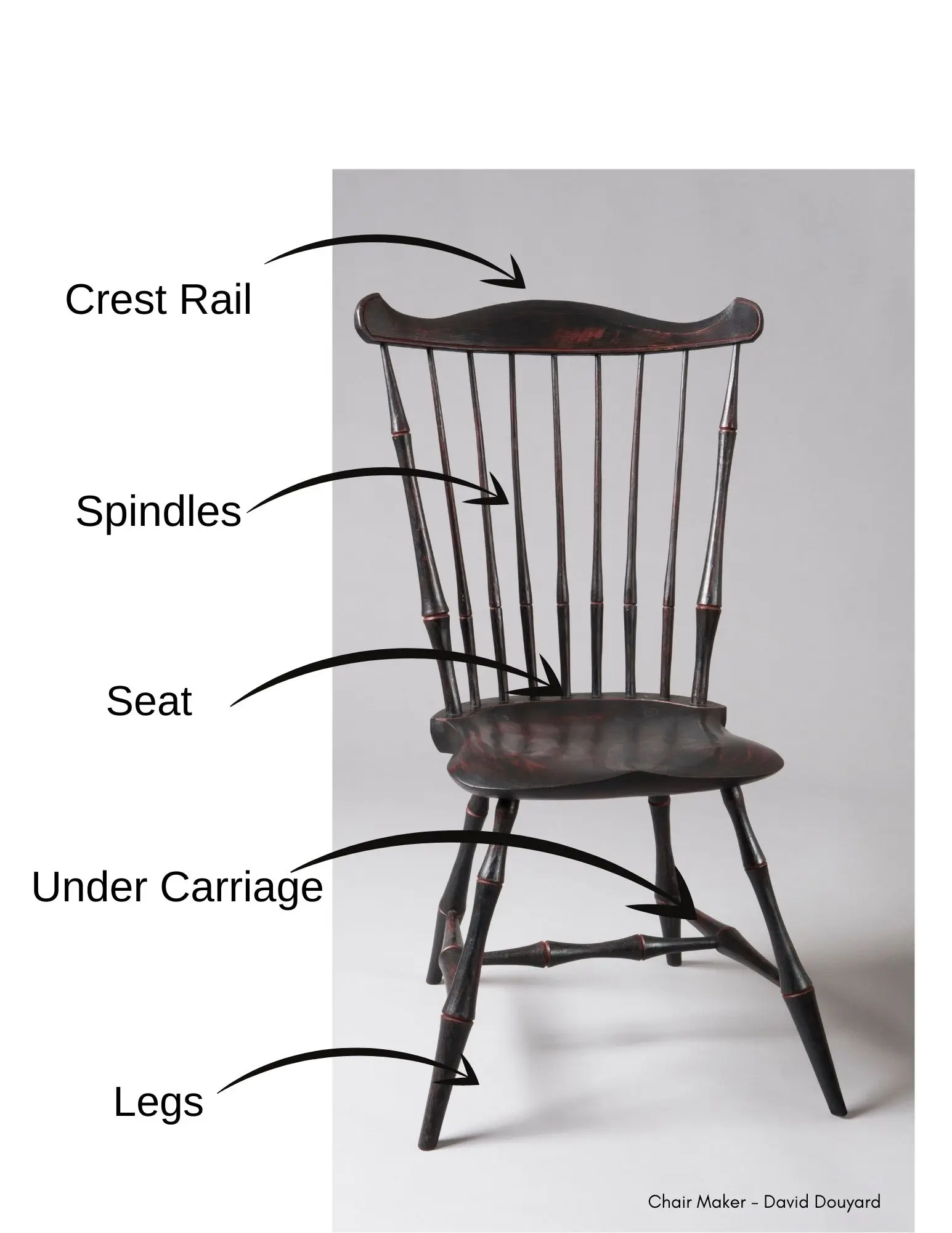
Photo from David Douyard's website
Further Reading
- Drew Langsner - A chapter from one of his books that discusses the differences between windsors and post-and-rung.
- Joel's Blog - Three Kinds of Chairs (Or Two) (Or Four)
- Layout Computer - Prototype chairs and some other furniture in 3D for free. Great for designing chairs and seeing how the different angles and heights affect the appearances.
- Lost Art Press - Chairmaking Books